
Burnout or Depression? How to Tell the Difference
You are tired in a way that sleep does not fix. Work feels like wading through wet sand. You used to like your job, or at least tolerate it, and now Sunday evening arrives with a weight in your stomach. Somewhere in there a question starts forming: is this just burnout, or is something more going on with me?
It is a good question, and it is a hard one to answer from the inside. Burnout and depression share a great deal of surface territory, which is why so many people spend months telling themselves they are only overworked. The distinction matters, though, because it changes what actually helps. This article walks through what each one is, where they overlap, some questions that can help you sort out which is which, and what to do with the answer.

Why These Two Get Confused So Often
Burnout and depression can feel nearly identical day to day. Both drain energy. Both make it harder to concentrate, harder to care, harder to be patient with the people you love. Both can show up in the body as headaches, stomach problems, muscle tension, or sleep that is either too short or never restful. If you were describing your week out loud, the description might sound the same either way.
There is a cultural layer too. Many of us were raised to treat exhaustion as ordinary, even honorable. If you grew up watching a parent work two jobs, or you are the first person in your family to hold a salaried position, or your household has always run on the assumption that you push through, then naming your own depletion can feel indulgent. That framing is understandable, and it also makes it easy to miss something that deserves attention.
What Burnout Actually Is
Burnout is a response to chronic, unmanaged stress in a specific context, most often work, though caregiving burnout is just as real. It is generally described as having three parts: deep exhaustion, growing cynicism or emotional distance from the work, and a sense that you are no longer effective at something you used to do well. It is not classified as a mental illness. It is understood as an occupational phenomenon, which is to say it is a signal about your circumstances.
The clearest feature of burnout is that it tends to be tied to a domain. When you step fully out of that domain, something in you loosens. A real vacation, a leave, a role change, or a boundary that finally holds will usually produce noticeable relief, even if it takes a couple of weeks. That relief is diagnostic in its own way, and it is also why burnout so often returns when someone goes back into the same conditions without anything having changed. Common signs include the following.
Dreading specific days, meetings, or shifts rather than dreading everything
Feeling detached, numb, or cynical about work you once cared about
Irritability that spikes at work and eases somewhat at home
Difficulty concentrating on tasks tied to the draining role
Physical exhaustion that improves during genuine time off
A sense of ineffectiveness or of never catching up
Still finding pleasure in things unrelated to the source of stress
What Depression Looks Like
Depression is a health condition, not a situation. It affects mood, thinking, sleep, appetite, energy, and the capacity to feel pleasure, and it typically shows up across the whole of life rather than in one compartment. Someone experiencing depression often notices that the things they used to look forward to have quietly gone flat, including the things that have nothing to do with work.
Depression also tends to carry a particular kind of self-directed thinking: I am failing, I am a burden, this is who I am now. Where burnout says the job is impossible, depression more often says I am the problem. That difference in the voice inside your head is one of the more telling distinctions, though it is not a diagnosis anyone should make on their own. It is also worth knowing that depression does not always look like sadness. For many people, especially those who have spent years being the reliable one in their family, it presents as irritability, flatness, physical pain, or a grinding sense of going through the motions while looking fine from the outside.
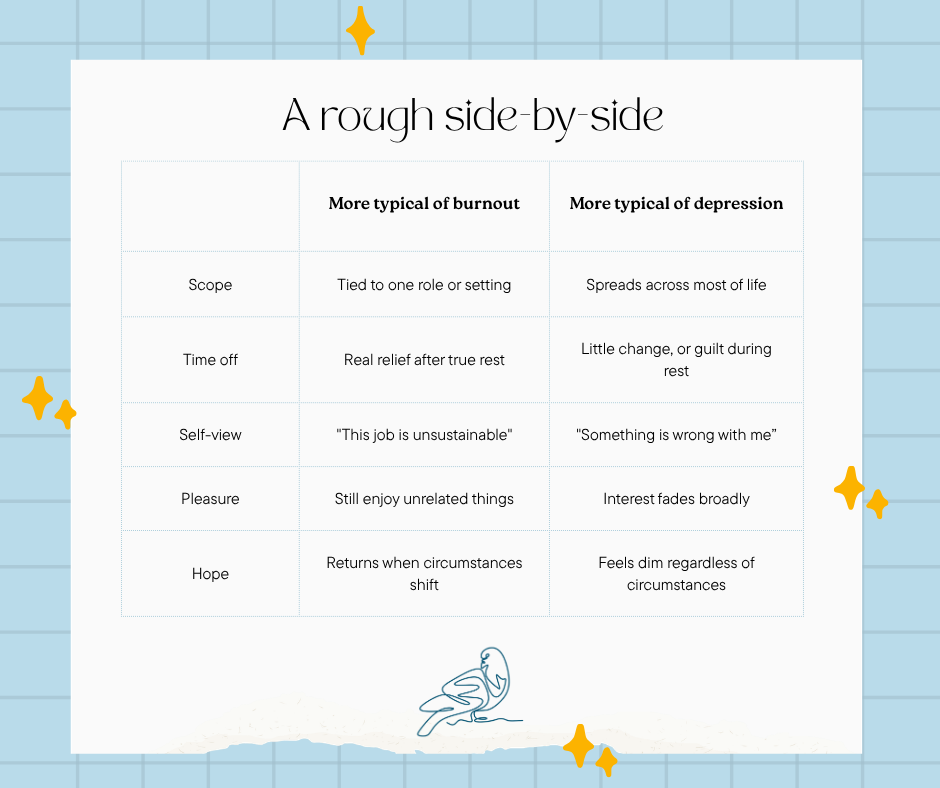
Treat this as a starting point for reflection rather than a test. Plenty of people have both at once: a punishing work situation that led to burnout, which in turn contributed to a depressive episode. Sorting that out is exactly the kind of thing an assessment with a clinician is for, and it is one of the most common questions people bring into a first session, along with practical concerns about cost, insurance, and what therapy actually involves, which are addressed in our frequently asked questions.
Five Questions to Sit With
None of these questions produce a verdict. They are meant to help you notice patterns you may have been too tired to see. Give yourself a quiet ten minutes and answer honestly, ideally in writing.
1. Does anything still feel good?
Think about the parts of your life untouched by your main source of stress: a friend, a meal, music, your kid's laugh, a walk in the evening. If some of those still register as pleasant, even faintly, that points more toward burnout. If nearly everything has gone gray, that is worth taking seriously.
2. What happens when you actually rest?
Not a weekend spent catching up on errands. A real stretch of days away from the demand. If a week off leaves you feeling noticeably more human, your circumstances are likely doing much of the damage. If rest brings guilt, dread, or no change at all, something else may be operating.
3. Whose fault does it feel like?
Listen for the shape of your own explanations. Burnout tends to sound structural: too many cases, not enough staff, an impossible schedule. Depression tends to sound personal and permanent: I used to be able to handle this, I am letting everyone down. Both can be present, and the second voice deserves company.
4. How long has this been going on?
Persistent low mood most of the day, on most days, for two weeks or longer is one of the markers clinicians pay attention to. If you are looking back over months and struggling to find a stretch when you felt like yourself, that timeline is information, not weakness.
5. What has changed in your body?
Notice appetite, sleep, and movement. Sleeping far more or far less than usual, significant weight change you did not intend, moving and speaking more slowly, or feeling physically agitated are all worth mentioning to a professional. Bodies often report distress before we are willing to.
If several of your answers pointed past simple exhaustion, that is not a diagnosis and it is not cause for alarm. It is a reasonable prompt to talk with someone who can help you look more closely.
What Helps, and What Helps More
Burnout responds to changes in load and boundaries: reducing hours where possible, renegotiating what you are responsible for, protecting genuine time off, rebuilding a life outside the role, and getting honest about what you cannot sustain. Therapy is useful here too, less as treatment for an illness and more as a place to figure out what needs to change and to face the guilt that often comes with changing it.
Depression usually calls for something more active. Talk therapy has strong evidence behind it, and for some people medication, evaluated by a prescriber, is part of the picture. Movement, sunlight, structure, and connection genuinely matter, though it is worth saying plainly that if self-care alone were sufficient, most people would have solved this already. Needing more than a better morning routine is not a personal failure.
If at any point you find yourself thinking about not being here, or feeling like a burden to the people around you, please treat that as a reason to reach out right away rather than to wait. The 988 Suicide and Crisis Lifeline is available by call or text at any hour in the United States.
Where to Go From Here
You do not have to arrive at a therapist's office with the answer already worked out. "I am exhausted and I do not know what this is" is a completely sufficient place to start, and figuring out whether you are looking at burnout, depression, or some tangle of both is part of the work rather than a prerequisite for it. What matters is that you stop waiting to see whether it resolves on its own after another quarter, another semester, another season of pushing through.
Alba Wellness Group provides individual therapy for adults across California, with in-person appointments in Panorama City and Lancaster and telehealth available statewide, in English and in Spanish. If any part of this article felt like a description of your last few months, that is worth an hour of your time and a conversation with someone whose job is to help you sort it out.
At Alba Wellness Group, we believe everyone deserves a space where they can heal, grow, and truly belong. If you're ready to take the next step in your journey, we're here to walk alongside you; contact us today for your free consultation.